RIGI 2026: Welcoming a New Cohort of Global Robotics Students
Following a highly competitive selection process, the Robotics Institute Germany Internship (RIGI) program at the Max Planck Institute for Intelligent Systems (MPI-IS) is preparing to welcome its 2026 cohort to Stuttgart.
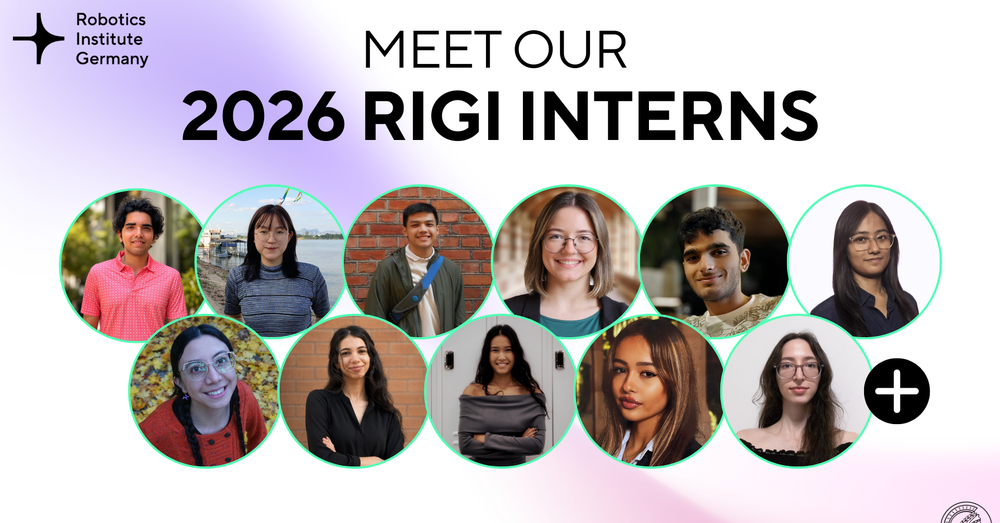
This summer, 25 bachelor’s and master’s students from around the world will join MPI-IS for research internships in robotics and artificial intelligence. Selected from 995 applicants across 75 countries, the cohort reflects the growing international visibility and reach of the program.
The 2026 interns represent a highly diverse group, with approximately 60% identifying as female. Students will join from 17 countries including Bangladesh, Brazil, Canada, China, Ecuador, Egypt, Germany, Greece, India, Indonesia, Kazakhstan, Nigeria, Poland, Serbia, Thailand, Turkey, and the United States, bringing a wide range of academic and cultural backgrounds and perspectives to the program. The new cohort consists of 60% bachelor’s and 40% master’s students. Interns will be supervised by 10 faculty members and supported by 29 day-to-day mentors across MPI-IS. The program continues to emphasize accessibility and inclusion, with 27% of interns identifying as first-generation students and 15% having no prior formal research or internship experience.
As in previous years, interns will work closely with faculty supervisors and day-to-day mentors across the institute. In addition, several projects in this year’s cohort are co-supervised with researchers from the University of Stuttgart, further strengthening collaboration within the Robotics Institute Germany (RIG) network.
The research projects span a broad range of topics at the intersection of robotics, AI, and human-centered technologies. These include teleoperation and surgical robotics, haptics, soft and biohybrid robotics, microrobotics, human–robot interaction, multimodal behavior analysis, and novel materials for robotics, among others. Together, they reflect the interdisciplinary nature of robotics research at MPI-IS.
Beyond their individual projects, interns will take part in a structured scientific and community program, including workshops, lab tours, career sessions, cross-site visits, and networking opportunities. The program is designed not only to provide hands-on research experience but also to foster exchange, collaboration, and a sense of community among early-stage researchers.
For many interns, the experience represents both a professional and personal milestone. As one incoming intern shares: “I’m most excited to see how robotic surgery can turn engineering into something directly meaningful for patients.” For some, the RIGI marks personal milestones: “This internship is also a big personal milestone for me, it's my first time traveling abroad, living independently, stepping out of my comfort zone, and getting a first real glimpse into the world of surgical robotics and research in Germany.”
At the same time, most interns highlighted their excitement for experiencing a new culture, trying different foods, adapting to a new language, and working alongside interns from around the world. Highlighting the collaborative aspect of the program, one intern shares: “I’m looking forward to working alongside interns from around the world and creating something meaningful together.”
Others emphasize the international and interdisciplinary environment: “What excites me most is contributing to research where engineering, imaging, and robotics come together to solve real clinical problems, from targeted drug delivery to next generation microrobotics. I'm equally looking forward to working alongside the scientists and interns, exploring the labs and campus, meeting my fellow RIGI interns, and brushing up on my German along the way.”
From contributing to real-world research challenges to experiencing a new cultural environment, the cohort arrives with a shared sense of curiosity and ambition. Interns will begin joining the institute throughout May, with July forming the core month of the program, and activities continuing into September. With interns beginning to arrive in Stuttgart in the coming weeks, RIGI 2026 marks another step in building a global, diverse, and collaborative robotics research community.